





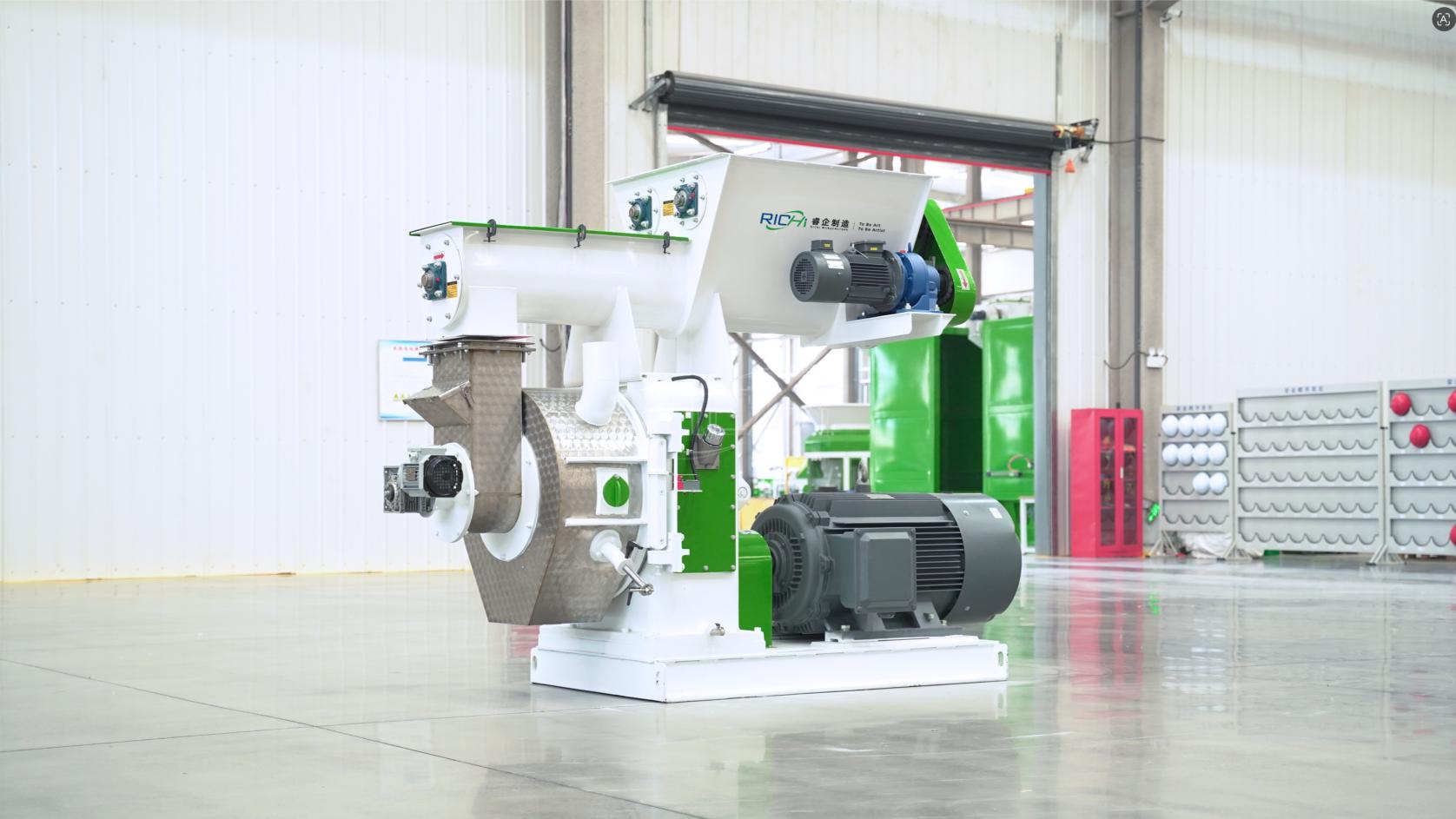
A palm kernel shell pellet machine converts hard PKS fragments into dense biomass fuel pellets for industrial boilers and power applications. RICHI’s MZLH range lists individual machine capacities from 0.2–0.3 t/h for the MZLH320 to 3–4 t/h for the MZLH768, while our complete project configurations can reach up to 10 t/h. The correct setup depends on shell moisture, contamination, particle size, required pellet quality, and the preparation equipment already available at the palm oil mill.
Why PKS Is Valuable—and Why It Is Difficult to Process
Palm kernel shells are generated during palm kernel extraction. RICHI’s product page gives a calorific value of approximately 4,000–4,500 kcal/kg, sulfur content below 0.2%, and pellet density around 600–750 kg/m³. Its FAQ also refers to ash content around 2–5% and sulfur below 0.15%. These are product-page reference figures; an export buyer should rely on laboratory analysis of the actual raw material and finished pellet batch.
PKS has an attractive energy profile, but its hardness and irregular shell shape make it more demanding than ordinary sawdust. Shells collected from mills, stockpiles and transport vehicles can contain sand, soil, stones, metal fragments and variable fiber residues. Sand increases abrasive contact on hammers, dies and rollers; a nail or screw can damage a hammer mill or trigger a sudden stoppage. A cleaning screen and magnetic separator are therefore production-protection equipment, not optional accessories to remove simply to lower the initial quotation.
For illustration, if contamination shortened a wear component’s service interval by 30%, a component normally changed every 1,000 operating hours would need attention after about 700 hours. This is a scenario calculation, not a measured PKS-wide wear rate. The actual effect depends on mineral content, screen performance, die material and operating load. The commercial point is simple: effective pre-cleaning is usually cheaper than repeated repairs and lost production time.
MZLH Models, Power and Capacity
Our MZLH model specifications are summarized below. They distinguish individual machine output from the larger plant capacity achieved by combining machines in a production cluster. They distinguish individual machine output from the larger plant capacity achieved by combining machines in a production cluster.
| Model | Main Motor | Arch-Breaking Feeder | Forced Feeder | Capacity |
|---|---|---|---|---|
| MZLH320 | 22 kW | 2.2 kW | 0.75 kW | 0.2–0.3 t/h |
| MZLH350 | 37 kW | 2.2 kW | 0.75 kW | 0.3–0.5 t/h |
| MZLH420 | 90 kW | 3 kW | 1.5 kW | 1.0–1.2 t/h |
| MZLH520 | 132 kW | 3 kW | 1.5 kW | 1.5–2.0 t/h |
| MZLH678 | 200 kW | 3 kW | 1.5 kW | 2.5–3.0 t/h |
| MZLH768 | 250 kW | 4 kW | 1.5 kW | 3.0–4.0 t/h |
The published ring die inner diameters range from 320 to 762 mm, with finished granule diameters of 4–12 mm. The page headline gives an overall solution range up to 10 t/h, but the largest individual model in the table is 3–4 t/h. The Malaysia example is an 8–10 t/h cluster made up of multiple lines, each designed around 4 t/h. When comparing offers, ask whether the stated output is per machine, per line or for the complete plant.
Raw Material Variability: Sand, Metal and Fiber
PKS quality can change between palm oil mills and even between deliveries from one supplier. Outdoor stockpiles may contain sand and soil; transport can introduce stones and metal; mixed shell and fiber streams can change bulk density and feeding behavior. A plant that designs its cleaning system around one clean sample may struggle when the supply mix changes.
| Contaminant or Variation | Production Consequence | Control Measure |
|---|---|---|
| Sand and mineral fines | Accelerated wear on hammers, ring die and rollers | Screening and raw-material grading |
| Stones | Impact damage and screen blockage | Pre-cleaning and size separation |
| Iron nails and screws | Hammer damage or unexpected stoppage | Magnetic separation before grinding |
| Variable fiber content | Changes feeding, grinding load and pellet formation | Blend control and representative testing |
| Wet or rain-exposed shells | Unstable feeding and higher drying duty | Covered storage and moisture checks |
In our Ghana project reference, we noted variation in impurity and fiber content between suppliers, making pre-treatment and wear resistance important. For any plant buying shells on the open market, incoming material control should be part of the operating plan—not something left to the pellet mill operator after a problem appears.
Moisture and Drying: Design for the Rainy Season
PKS does not always need intensive drying. RICHI’s Ghana and North Sumatra project examples report natural moisture around 8%–12% and 10%–12%, respectively. Its biomass planning reference uses approximately 20% maximum moisture before pelleting. Wet storage and rainy-season collection can change that decision, so a dryer should not be omitted based on one dry-season sample.
Consider a 1,000 kg/h feed stream on a wet-basis calculation. At 25% initial moisture and a 12% target, dry solids are 750 kg/h and dried product flow is about 852 kg/h; the dryer removes approximately 148 kg/h of water. At 35% initial moisture, dry solids are 650 kg/h and dried product flow is about 739 kg/h; water removal rises to approximately 261 kg/h. That is around 76% more evaporation duty for the same wet-feed rate.
This difference changes dryer size, thermal input, fuel handling and operating cost. Measure PKS moisture during both dry and rainy seasons. If shells remain near 8%–12% throughout the year, a full dryer may not be justified. If deliveries regularly exceed the process range, drying capacity or covered raw-material storage becomes part of the project design.
Machine Engineering for Hard, Abrasive Shells
42CrMo ring die and rollers
For PKS duty, we specify 42CrMo steel for the ring dies and rollers. For the Malaysia export-oriented cluster, it also describes tungsten-carbide rollers. Confirm the exact component supplied for the selected model because the wear package can vary with raw material and project duty.
Arch-breaking and forced feeding
Irregular shell fragments can hang above the hopper outlet. RICHI’s arch-breaking feeder uses two rotating shafts to agitate material, while the forced feeder helps deliver a steady flow into the pelleting chamber. These systems matter because uneven feed causes load fluctuation and can reduce practical output even when the motor and ring die are correctly sized.
Gear drive, main shaft and lubrication
Our standard configuration describes a Siemens main motor, gear transmission and quenched main shaft. Our technical comparison indicates a 15% transmission-efficiency improvement over traditional belt transmission. This is a manufacturer-stated comparison and should be tied to the actual drive configuration before being used in a project guarantee. Automatic lubrication supplies key transmission and bearing points, while a safety pin is designed to disconnect the drive under overload.
Complete PKS Pellet Production Line
| Process Stage | Typical Equipment | Engineering Purpose |
|---|---|---|
| Receiving and cleaning | Hopper, screen, magnetic separator | Remove soil, stones and metal before size reduction |
| Size reduction | Chipper or hammer mill | Prepare consistent particles for compression |
| Moisture control | Rotary dryer and hot-air system (if required) | Bring feedstock into the tested moisture range |
| Feeding and transfer | Bins, conveyors, metering feeder | Maintain continuous feed to the pellet mill |
| Pelletizing | MZLH ring-die pellet machine | Form dense biomass pellets |
| Cooling and screening | Counterflow cooler, grading screen | Stabilize pellets and remove fines |
| Packing | Bagging scale | Prepare product for storage and dispatch |
A dryer should not be added automatically if clean shells remain dry throughout the year. Conversely, omitting drying solely to reduce initial investment can leave the plant unable to process wet-season material. In our Colombia project, the line processes EFB fiber, PKS and mesocarp fiber; its 5–6 t/h line includes a chipper, hammer mill, rotary dryer, pellet machine, counterflow cooler and automatic packing. Mixed palm residues create a different preparation route from pure PKS.
Avoid the Production-Line Bottleneck
A 2 t/h pellet mill will not produce 2 t/h of finished pellets if the crusher supplies only 1.5 t/h or the cooler can handle only 1.7 t/h. Compare usable capacities on the same feedstock and moisture basis. For an illustrative line, a 2.2 t/h crusher, 2.0 t/h dryer, 2.0 t/h pellet mill, 1.8 t/h cooler and 2.0 t/h packing system will be limited by the cooler to roughly 1.8 t/h before downtime and screening losses.
Selected auxiliary sections may need a 10%–20% capacity margin, depending on material variability and operating schedule. This is a preliminary engineering allowance, not a fixed rule. The recommendation changes if the factory has buffer storage, parallel equipment or an existing section that can be independently upgraded. The key is to size the complete route, not just the pellet mill.
Finished PKS Pellet Quality and Export Buyer Requirements
Industrial buyers evaluate more than pellet diameter. Calorific value, moisture, ash, sulfur, chlorine, bulk density, mechanical durability and fines content can all affect acceptance and boiler performance. We use pellet density around 600–750 kg/m³ as a design reference and commonly configure pellet diameters from 6–12 mm, with 6–8 mm used in some industrial fuel applications.
Some buyers may specify mechanical durability above 96%, but this is not a universal PKS acceptance limit. Obtain the actual fuel specification from the boiler operator or importer before selecting the die and cooling system. Ash and chlorine should be tested on representative batches; soil contamination can raise ash, while the actual chlorine result depends on the feedstock and supply chain. A factory should not promise export compliance from appearance or machine settings alone.
Global Project Examples: Ghana, Indonesia, Colombia and Malaysia
RICHI’s published examples show how raw-material conditions change the configuration. In eastern Ghana, an MZLH350 handles approximately 0.3–0.5 t/h of shells at 8%–12% moisture and produces 6–8 mm pellets for trial use in local boilers. In western Ghana, supply from different vendors brings variation in impurities and fiber content, making pre-treatment and wear resistance more important.
In North Sumatra, Indonesia, a 2.5–3 t/h biomass energy project uses naturally dry shells at around 10%–12% moisture and integrates new equipment with existing crushing and conveying systems. In Colombia, a 5–6 t/h line processes EFB fiber, PKS and mesocarp fiber, so the scope includes more extensive size reduction and drying. In Malaysia, an 8–10 t/h export-oriented cluster uses multiple lines, each designed around 4 t/h, with 42CrMo ring dies and tungsten-carbide rollers described for the hard shell feedstock.
Investment Example for a 2 t/h PKS Pellet Plant
Consider a project near palm oil mills in Indonesia or Malaysia. The supplied planning reference places a complete 2 t/h equipment investment around USD 120,000–180,000, depending on whether the plant already has storage, crushing, drying and conveying equipment. This is a project estimate, not a standard package quotation.
| Assumption | Illustrative Value |
|---|---|
| Rated finished capacity | 2 t/h |
| Operating hours | 10 h/day |
| Operating days | 25 days/month |
| Effective utilization | 80% |
| Monthly finished output | 400 tonnes |
| Project investment | USD 150,000 |
| Net contribution after variable costs | USD 20/t |
Monthly contribution is 400 × USD 20 = USD 8,000. Simple payback is USD 150,000 ÷ USD 8,000, or approximately 18.75 months. This calculation excludes financing, tax, depreciation and working capital. Net contribution must be calculated after raw material, electricity, drying fuel, labor, packing, maintenance and logistics; gross pellet selling price is not profit.
PKS vs. EFB: Which Palm Residue Should You Process?
| Factor | PKS | EFB |
|---|---|---|
| Physical structure | Hard shell fragments | Long fibrous material |
| Moisture profile | Can be relatively dry | Generally higher moisture |
| Preparation priority | Cleaning, crushing, wear protection | Shredding, dewatering, drying |
| Main equipment challenge | Abrasive wear and feeding | Fiber handling and water removal |
| Investment sensitivity | Cleaning and wear parts | Pre-treatment and drying duty |
Clean, dry PKS can be a comparatively straightforward biomass pellet feedstock. EFB may be attractive where it is available in large quantities at low cost, but shredding and drying can dominate the project design. The best choice depends on local supply, competing uses, transport distance, and the buyer’s fuel specification—not simply on theoretical calorific value.
For machine specifications and a project-specific configuration, see the RICHI palm kernel shell pellet machine models and technical details.
Conclusion
A successful PKS pellet plant is built around raw-material control, not just the pellet mill. Screening and magnetic separation protect expensive working components; seasonal moisture data determines whether drying is necessary; the crusher, dryer, pellet mill, cooler and packing system must be capacity-matched; and the finished pellets must meet the buyer’s fuel specification. RICHI’s MZLH models provide individual machine options from approximately 0.2 to 4 t/h, while larger projects can use multiple lines. The right investment converts available shells into accepted fuel at a competitive and repeatable cost per tonne.
Frequently Asked Questions
What is the capacity of a palm kernel shell pellet machine?
The published MZLH model table ranges from 0.2–0.3 t/h for the MZLH320 to 3–4 t/h for the MZLH768 per machine. Larger plant capacity can be achieved with multiple lines; our complete project configurations can reach up to 10 t/h.
Does PKS need drying before pelletizing?
Not always. RICHI’s Ghana and Indonesia examples report natural moisture around 8%–12% and 10%–12%. Wet-season or rain-exposed shells may require drying. Use seasonal moisture measurements and the selected machine’s tested operating range to make the decision.
What pellet diameter can the MZLH machine produce?
The published model table lists 4–12 mm finished granules. RICHI’s project examples include 6–8 mm pellets, while the target fuel buyer should determine the final diameter.
Is a binder required for PKS pellets?
PKS can generally be pelletized using its natural binding properties. Whether an additive is needed depends on shell composition, moisture, die compression and the required durability; a material trial should confirm the result.
What quality tests are important for export PKS pellets?
Commonly assessed properties include calorific value, moisture, ash, sulfur, chlorine, bulk density, mechanical durability and fines. The buyer’s written fuel specification should define the acceptance limits; a durability figure above 96% is one possible buyer requirement, not a universal standard.
Why is magnetic separation needed?
It removes ferrous contaminants such as nails and screws before they reach the hammer mill and pelletizing equipment. This reduces the risk of impact damage and unexpected downtime.
How should a 2 t/h PKS line be sized?
Check the usable capacity of cleaning, crushing, drying, feeding, pelletizing, cooling, screening and packing on the same raw-material basis. The finished line output is constrained by the slowest process section, not the pellet mill’s nameplate rating.