


Aquaculture is becoming increasingly sophisticated. Modern fish and shrimp farms are no longer focused only on maintaining animal growth. Producers are also paying close attention to feed conversion, feeding behavior, water quality, labor efficiency, raw material costs, and production consistency.
Among these factors, feed deserves special attention because it connects the factory directly with farm performance.
A nutritionally balanced formula can still perform poorly if it is manufactured incorrectly. Pellets that break apart too quickly can increase feed loss. Pellets that are too large can be difficult for small animals to consume. Feed with inconsistent density may behave differently in the water from one batch to another. Excessive moisture can create storage problems, while over-drying can unnecessarily increase energy consumption.
This is why modern feed production should be viewed as a complete process rather than a collection of individual machines.
A properly configured aquatic feed pellet plant brings together raw material preparation, grinding, mixing, extrusion, drying, cooling, coating, screening, and packaging. The purpose of this system is not simply to produce a large amount of feed. It is to create a consistent product that matches the nutritional and physical requirements of specific aquatic species.
Begin with the Product You Want to Sell
Many equipment projects start by asking about machine capacity.
A better starting point is the finished product.
Before choosing equipment, producers should define what they actually want to manufacture.
Will the feed be used for shrimp, tilapia, carp, catfish, trout, salmon, or another species?
Will it float, sink, or slowly sink?
What pellet diameter is required?
How long should the pellet remain stable in water?
Will the product be designed for juvenile animals, grow-out animals, breeders, or several growth stages?
Each answer affects the design of the production process.
A feed factory producing one simple product may need a very different setup from a commercial manufacturer supplying several species.
Understanding the Target Species
Aquatic animals do not all feed in the same way.
Some fish feed actively at the surface. Others prefer feed at different depths of the water column. Shrimp generally feed close to the bottom, making sinking behavior and water stability especially important.
Feed particle size is also linked to animal size.
(Related Post: https://www.richipelletmill.com/twin-screw-fish-feed-extruder/)
Juvenile fish require smaller feed because of their limited mouth opening. As animals grow, pellet dimensions can increase.
This creates a practical requirement for many commercial manufacturers: the production system should allow multiple pellet specifications.
A plant designed for flexibility can serve several feed products without requiring major structural changes.
Raw Materials Determine Processing Behavior
The quality of a finished pellet starts long before the material reaches the forming stage.
Aquatic feed formulas may contain ingredients such as fish meal, soybean meal, corn, wheat flour, rice bran, vegetable protein concentrates, oils, minerals, vitamins, attractants, and functional additives.
These ingredients behave differently during processing.
Some provide starch and help support pellet structure.
Others contribute protein but may require different processing conditions.
Oils can increase energy density but can also affect lubrication during extrusion.
Fibrous materials may influence flowability and pellet formation.
Because of these differences, a successful feed plant should be designed around the actual formula rather than a generic recipe.
Raw Material Inspection Is Worth the Effort
Feed manufacturers often receive ingredients from different suppliers or production batches.
Even when the ingredient name remains the same, physical properties can change.
Moisture may vary.
Bulk density may change.
Particle size can differ.
Storage conditions can affect quality.
These differences influence the production process.
For example, higher moisture may change extrusion behavior and increase drying requirements. A different particle size distribution may affect mixing and pellet formation.
Simple incoming-material checks can therefore help stabilize the production environment.
Useful indicators may include moisture, bulk density, particle size, appearance, foreign materials, and storage condition.
Grinding Creates the Right Starting Point
Grinding is one of the most important upstream processes.
Raw ingredients often need to be reduced to a suitable particle size before mixing and extrusion.
Uniform particles can improve mixing consistency and make the feed easier to process.
This is particularly important for small aquatic feed pellets because the finished products can have diameters of only a few millimeters.
However, excessively fine grinding is not always advantageous.
It requires more electricity and can create additional dust. The correct particle size should therefore be based on the formula and product requirements.
A good grinding system should provide sufficient size reduction without unnecessary energy consumption.
Mixing Determines Ingredient Distribution
A feed formula may contain ten or more components.
Some ingredients are included at relatively high percentages, while others are present in very small quantities.
The mixing stage must distribute these materials consistently.
A poor mixing process can create nutritional variation between pellets.
This problem may be invisible because the finished feed can still look uniform.
For commercial manufacturers, mixer performance should therefore be evaluated using actual batch consistency rather than simply relying on the machine’s nominal capacity.
Mixer loading, mixing time, material characteristics, ingredient sequence, and discharge method can all affect uniformity.
Why Processing Technology Matters
Once ingredients have been prepared and mixed, they need to be transformed into a stable physical product.
This can involve different technologies depending on the feed type.
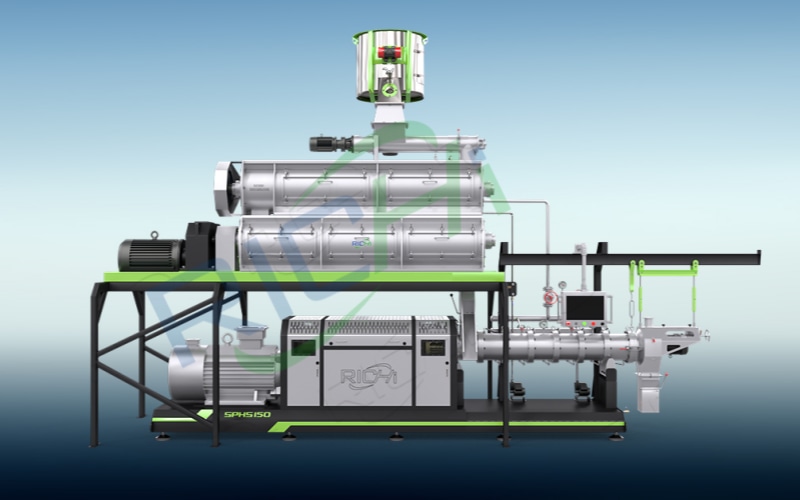
Extrusion is particularly useful for many aquatic feeds because it allows producers to influence pellet density and internal structure.
Heat, moisture, mechanical shear, and pressure interact during processing.
The result can be a feed product with different physical characteristics depending on the operating conditions.
This flexibility can be important when a manufacturer needs to make both floating and sinking products.
Floating Feed Requires Controlled Expansion
Floating feed is widely used for species where farmers benefit from observing feeding activity on the water surface.
The ability to see the pellets can help farmers adjust feeding rates.
However, producing floating feed requires careful control of pellet density.
The material needs to develop an internal structure that allows the finished pellet to remain at the surface.
This depends on more than the extruder itself.
Ingredient composition, starch level, moisture, processing temperature, die design, screw configuration, and operating conditions all contribute to the result.
Small changes in these factors can influence floating performance.
Sinking Feed Requires a Different Structure
Sinking feed is designed to move downward through the water.
The target density depends on the species and feeding environment.
A pellet that sinks extremely quickly may accumulate on the bottom before animals can consume it. A pellet that remains suspended for too long may not reach the intended feeding area.
The correct result is therefore a balance between density and feeding behavior.
For shrimp, this requirement becomes particularly important because farmers need the feed to reach the bottom while remaining stable long enough for the animals to consume it.
Planning Commercial Shrimp Feed Production
Shrimp feed manufacturers often require tighter control over pellet size and water stability than many general-purpose feed operations.
A producer considering a 4-5 T/H shrimp feed manufacturing plant for sale should therefore evaluate the complete production system.
Hourly capacity is important, but it is not enough.
The producer should also consider:
- Target shrimp species
- Growth stages
- Pellet diameter
- Formula composition
- Water stability
- Sinking behavior
- Drying requirements
- Coating requirements
- Packaging
- Storage
- Automation
The more products a factory intends to manufacture, the more important process flexibility becomes.
Why Pellet Stability in Water Matters
The moment aquatic feed enters water, the production process faces another test.
The pellet must retain its physical structure for a suitable period.
If it disintegrates too quickly, valuable nutrients can be released into the surrounding water.
This can increase feed waste and potentially contribute to deteriorating water quality.
However, maximum water stability is not automatically the goal.
Different species have different feeding times.
The desired stability should therefore be based on practical feeding conditions.
Feed manufacturers may test pellets under different water temperatures and durations to determine whether the product behaves as intended.
Pellet Durability Before It Reaches the Farm
Water stability is only one side of pellet quality.
The pellet also needs to survive handling before it enters the water.
During production, pellets may pass through:
Extrusion → drying → cooling → coating → screening → conveying → storage → packaging → transportation.
Each step creates potential mechanical impact.
If pellets are weak, fines can increase.
Excessive fines reduce product consistency and may create handling problems.
A durable pellet should therefore remain intact throughout normal factory and transportation conditions.
Drying Needs Careful Control
After extrusion, feed typically contains more moisture than is suitable for long-term storage.
Drying reduces this moisture.
Yet the purpose is not simply to remove as much water as possible.
Over-drying can waste energy and may alter pellet characteristics.
Under-drying can create storage and quality problems.
A well-designed drying process should control temperature, airflow, residence time, and moisture reduction according to the specific product.
Dryer capacity should also be matched to upstream production.
An extrusion line can only operate continuously when drying capacity can keep up with the feed output.
Cooling Is Essential Before Storage
Dried pellets can still be hot.
Packaging hot feed can lead to temperature differences and moisture migration inside the package.
Cooling brings the feed to a suitable temperature for downstream handling and storage.
In commercial production, cooling should be treated as a core process rather than an optional addition.
The correct cooling capacity depends on product characteristics, production rate, ambient conditions, and desired final temperature.
Coating for High-Value Feed Products
Some aquatic feeds require oils or other liquid ingredients after drying.
Coating equipment can help apply these materials evenly to the surface of the pellets.
Certain products may benefit from additional energy supplied through oils.
Others may use attractants or functional additives to improve feeding response.
The coating system needs to provide uniform application.
Inconsistent coating can lead to variation in product composition and create problems during storage or handling.
For manufacturers producing premium feed, accurate coating can therefore become an important part of the process.
Pellet Size Requires Flexibility
Aquatic feed is rarely limited to one pellet diameter.
Young shrimp and juvenile fish may need very small pellets.
Larger animals require larger feed.
Commercial plants serving different markets may therefore need several pellet sizes.
Changing pellet size may involve replacing dies or adjusting associated equipment.
The plant layout should provide adequate space for die changes, storage, and product separation.
A flexible configuration makes it easier to respond to customer demand without major modifications.
The Role of a Modern pelleting machine
Although extrusion is common for aquatic feed, pellet formation technology must always be selected according to the product.
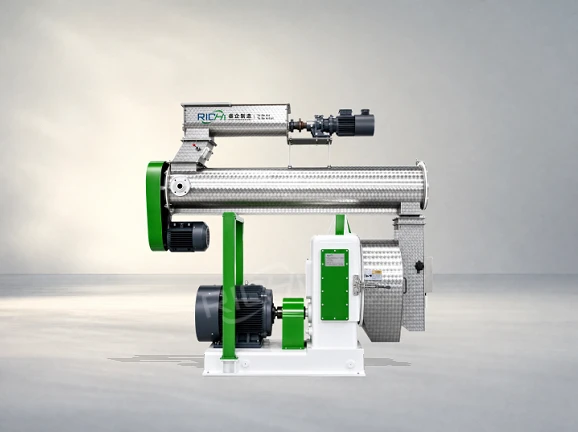
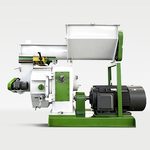
A pelleting machine can be appropriate for certain aquatic feed applications where the formula and desired physical properties are compatible with conventional pelletizing.
The choice between technologies should consider factors such as:
- Floating or sinking requirements
- Pellet density
- Formula composition
- Desired water stability
- Production capacity
- Pellet diameter
- Energy consumption
- Product range
The important point is that the forming technology should serve the feed specification.
There is no universal machine that is perfect for every aquatic feed formula.
Balancing the Production Line
A production plant is only as strong as its weakest process section.
Consider a line with an extrusion capacity of 5 T/H.
If the grinder prepares only 3 T/H, the extruder cannot run at its full potential.
If the dryer can handle only 4 T/H, production must slow down.
If packaging is too slow, finished feed may accumulate before the bags can be filled.
For this reason, capacity should be balanced across the entire line.
The objective is stable material flow rather than isolated high specifications.
Automation and Process Control
As production volumes increase, automation can make feed manufacturing more consistent.
Automatic batching can improve ingredient accuracy.
Centralized control can simplify machine management.
Sensors can monitor temperature, moisture, motor load, and production status.
Automatic packaging can reduce labor requirements.
Automation is particularly useful for factories producing several formulas because repeatability becomes more difficult to maintain manually.
However, automation should be selected according to actual operational needs.
A small internal feed operation may benefit from a simpler control structure, while a large commercial manufacturer may require a much more comprehensive system.
Energy Efficiency Becomes More Important as Capacity Grows
Energy consumption has a direct effect on production costs.
Grinding requires electrical power.
Extrusion requires mechanical and thermal energy.
Drying can become one of the largest energy-consuming processes.
Cooling, conveying, coating, and packaging also contribute.
When designing a larger factory, energy consumption should be evaluated on a per-ton basis.
A machine with a large motor is not automatically inefficient. What matters is how much usable feed is produced for the energy consumed.
Process optimization, properly sized equipment, insulation, heat management, and reduced idle operation can all contribute to better energy performance.
Maintenance Should Be Planned from the Beginning
Reliable feed production requires regular maintenance.
Wear can occur in screws, dies, cutters, bearings, screens, conveyors, dryers, fans, and other components.
A component does not always need to fail before it becomes a quality problem.
For example, gradual wear may change pellet dimensions or reduce production rate.
Operators should therefore watch for:
- Abnormal vibration
- Increasing motor load
- Changes in pellet appearance
- Higher fines
- Reduced output
- Temperature changes
- Unusual equipment noise
A preventive maintenance program can help reduce unexpected shutdowns.
Storage Protects the Value Created by the Factory
A high-quality feed pellet can still lose value through poor storage.
Finished feed should be kept in a dry, clean, ventilated environment.
Humidity should be controlled.
Products should be protected from pests and contamination.
Bulk storage systems should minimize segregation.
Bagged feed should be handled carefully to avoid excessive mechanical damage.
In warm climates, storage temperature is particularly important because heat can accelerate quality deterioration.
Choosing a Supplier for a Complete Project
Feed processing is not only about equipment manufacturing.
Project layout, installation, commissioning, process adjustment, operator training, spare parts, and after-sales service can all affect long-term performance.
A supplier with experience in complete feed projects can help identify potential bottlenecks before equipment is installed.
Companies such as Richi Machinery can provide equipment and technical solutions for different feed processing applications. However, buyers should always evaluate a project based on their own formulas, raw materials, capacity, and product requirements.
The supplier’s ability to understand the entire process is often more valuable than a single attractive machine specification.
Why Testing Should Be Part of Project Planning
New feed projects frequently involve ingredients or formulas that have not been processed with the selected equipment before.
Trial production can therefore provide useful information.
Testing may reveal differences in:
- Moisture behavior
- Pellet density
- Expansion
- Durability
- Water stability
- Production rate
- Energy consumption
These findings can then be used to optimize the final equipment configuration.
For unusual raw materials or specialized formulas, practical testing can reduce the risk of expensive modifications later.
Building for Future Growth
An aquaculture business may change significantly over several years.
A producer may start with shrimp feed and later add tilapia products.
A regional feed mill may expand into neighboring markets.
A farm may increase production capacity.
This makes future flexibility valuable.
Plant layouts can leave room for additional storage silos, conveyors, dryers, extruders, packaging units, or other equipment.
Control systems can also be designed to accommodate additional formulas and production stages.
Planning for expansion at the beginning can reduce reconstruction costs later.
Common Errors in Aquatic Feed Plant Planning
Several avoidable mistakes can reduce plant performance.
Choosing Equipment Before Defining Product Requirements
Without specific pellet targets, machine selection can become guesswork.
Focusing Only on Main Equipment
The dryer, cooler, coating system, screening equipment, and packaging machines also influence production capacity.
Ignoring Raw Material Variability
Different moisture and ingredient properties can change processing behavior.
Overestimating Capacity
An oversized plant can suffer from poor utilization and high unnecessary investment.
Underestimating Drying Costs
Drying can have a major influence on energy consumption.
Treating Storage as an Afterthought
Poor storage can reduce the quality of feed after all the production work has been completed.
A Better Way to Evaluate Equipment
Instead of comparing machines only by price and hourly output, producers can build a broader evaluation framework.
Consider:
Product compatibility
Production capacity
Energy use
Automation
Maintenance
Spare parts
Installation
Technical support
Future expansion
Finished product quality
This approach provides a more realistic picture of the long-term value of the investment.
How Feed Quality Influences Farm Performance
The final purpose of an aquatic feed factory is not to create a visually attractive pellet.
It is to produce feed that performs effectively in the farming environment.
A well-designed pellet can improve feeding consistency.
Appropriate size can support better consumption.
Suitable water stability can reduce unnecessary nutrient loss.
Stable density can improve feed distribution.
Consistent formulation can help maintain predictable nutritional intake.
Together, these factors can contribute to better feed management at the farm level.
Feed Production and Water Management Are Connected
One of the most important differences between aquatic and terrestrial feed production is the relationship between feed quality and water quality.
When feed is wasted, the impact does not stop at the lost ingredients.
Uneaten feed can contribute to nutrient accumulation in water.
This can increase the biological load of a pond or tank and create additional management challenges.
Better feed quality therefore supports not only feeding efficiency but also environmental control.
This is another reason why pellet stability, size, density, and feeding behavior should be evaluated carefully.
The Future of Aquatic Feed Manufacturing
Feed production is likely to become more precise in the coming years.
Sensors and control systems can provide more information about production conditions.
Automation can improve formula accuracy.
Advanced extrusion technologies can offer greater control over pellet structure.
Drying systems can become more energy-efficient.
Coating systems can apply functional ingredients more accurately.
At the same time, feed manufacturers will likely continue developing new formulas based on alternative protein sources, improved nutrient utilization, and changing aquaculture practices.
These changes will make flexible processing systems increasingly important.
Final Thoughts
Modern aquatic feed production is a combination of nutrition, engineering, process management, and practical farming requirements.
The factory needs to begin with the target species and formula.
Raw materials need to be prepared correctly.
Grinding and mixing need to provide consistent feed material.
Processing technology needs to create the desired pellet structure.
Drying and cooling need to protect the finished product.
Coating and screening need to deliver consistent quality.
Packaging and storage need to preserve that quality until the feed reaches the customer.
Most importantly, the complete process needs to be balanced.
A plant that produces a high volume of inconsistent feed is not necessarily efficient. A smaller system with stable production, good energy utilization, and excellent product quality may provide much greater practical value.
For producers planning a new project, the most effective strategy is to define the final product first and then work backward toward equipment selection.
That means understanding the animal, feeding behavior, pellet size, density, water stability, raw materials, capacity, storage, energy consumption, and future expansion plans.
Once these factors are clear, it becomes much easier to create a feed processing system that is reliable, efficient, and commercially practical.
Aquaculture will continue to evolve, and feed manufacturing will need to evolve with it. Producers that invest in flexible processes, consistent quality control, and balanced equipment configurations will be better positioned to respond to changing market demands.
For more technical information, equipment comparisons, and related production considerations, click to investigate additional resources before making a long-term investment decision.